Doblada en Tres: How a Folded Piece of Paper Became the Movement's Smallest Weapon
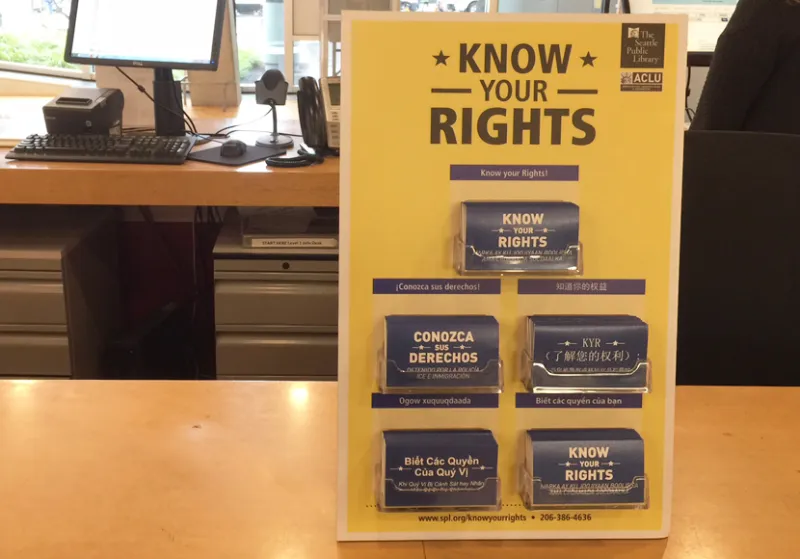
Photo: hands holding bilingual know your rights card at laundromat counter, via www.spl.org
There's a moment that repeats itself in bodegas and laundromats from Houston to Providence: someone folds a small paper into thirds, slides it across a counter, and says, almost in a whisper, guárdala por si acaso.
The paper is a carta de derechos — a bilingual know-your-rights card that has quietly become the most portable organizing tool in the immigrant rights movement. It costs pennies to print. It fits behind a phone case. And lately, it's doing something no lawsuit or press conference can: it travels.
From Handout to Handshake
The cards aren't new. Legal aid organizations have printed versions of them since the early 2000s, usually listing the basics: you have the right to remain silent, you don't have to open the door, you don't have to sign anything. For years they lived in stacks at nonprofit front desks, handed out once, forgotten in kitchen drawers.
What's changed is the distribution strategy. Community groups now treat the cards less like safety literature and more like campaign material — because that's essentially what they've become. Volunteers stock them at laundromat change machines, tuck them into church hymnal racks, leave them tucked in the plastic sleeves of baby stroller displays at WIC offices. In some cities, the cards come with a QR code that links to a live map of verified legal observers and rapid-response hotlines.
"We print them like we're running for office," one organizer with a Denver-based legal collective told us. "Because in a way, we are. The campaign is: everybody in this neighborhood knows their rights before anyone knocks on a door."
The Card as a Signal
Here's the part that surprises people who've never organized in an immigrant community: the card's power isn't only informational. It's social.
Carrying one says something. Accepting one says something else. When a cashier slips a card into your receipt, it's an act of trust between two people who may have never spoken. The card has become a quiet signal — a way of asking are you with us? without saying a word in front of the wrong person.
That's why the design matters as much as the text. The newer generations of cards are deliberately beautiful: bold typography, artwork from local muralists, colors that match the neighborhood's flags and banners. One version circulating in the Central Valley is printed to look like a lottery ticket — a joke, but also camouflage. Another folds out into a mini poster for the next marcha.
Legal aid groups have noticed. Several now coordinate their card releases with organizing calendars, timing new print runs to enforcement surges or court dates the way a campaign times its mailers. Some cards are versioned, updated quarterly, like software.
Where the Cards Go When They Can't Be Seen
Distribution in a climate of surveillance requires creativity. Cards get sewn into jacket linings at sewing circles that double as know-your-rights trainings. Sunday school teachers hand them to parents alongside the kids' artwork. Barbers keep a stack under the register, next to the loteria tickets.
And the cards migrate. People mail them to cousins in states without established legal aid networks. They get photographed and texted across family group chats — a jpeg of a folded card, passed around like a recipe.
This is the part that should worry anyone who thinks the movement is fragile: the infrastructure is already in every pocket. You can't seize a stack of paper that's been dispersed through a thousand laundromats, a hundred churches, a million group chats.
More Than a Folded Page
Critics sometimes dismiss the cards as symbolic — paper against an enforcement apparatus with budgets in the billions. But symbolism is how movements metabolize fear into participation. The card is often the first political act a person takes: reading it, keeping it, handing it to someone else. Organizers will tell you plainly — the person who takes a card today is the person who shows up to the training next month, and to the courthouse steps the month after.
The revolution doesn't always announce itself with a bullhorn. Sometimes it arrives folded in thirds, printed on cheap paper, bilingual on both sides, waiting patiently in a pocket for the moment it's needed.
Si tienes una, pásala. Ese es el punto.