The Kids Who Were Never Just Kids: Bilingual Teens Turn a Lifetime of Translating Into Organizing Power
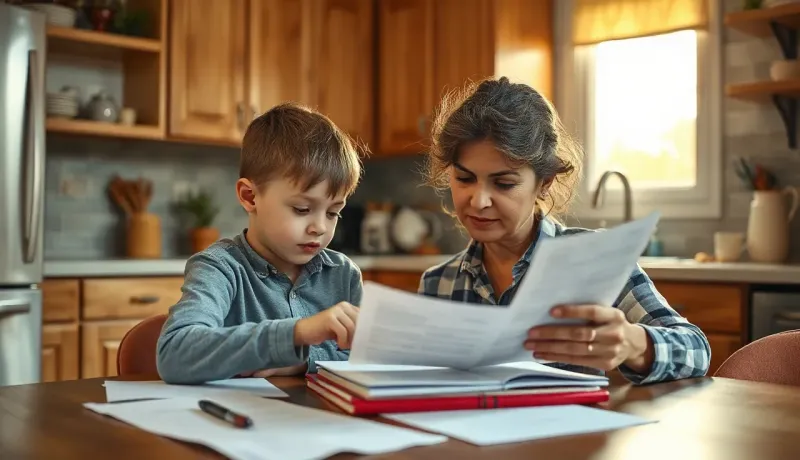
Photo: bilingual teenager translating document for parent at kitchen table, via readflare.com
The first thing Marisol Duarte ever translated was a late-rent notice. She was eight years old, standing in the kitchen of her family's apartment in Fresno, reading her mother a document that would decide whether they had a home. Nobody trained her for it. Nobody thanked her. That was just the deal when you were the kid who spoke English.
Fast-forward a decade, and Duarte is standing in front of forty families in a church basement in the Central Valley, walking them through a court filing for a rent strike defense — in two languages, at once, without notes. She's seventeen. She still has chemistry homework due Friday.
The Invisible Résumé
If you grew up bilingual in a working-class immigrant family, you know the job. You interpreted at the bank, the clinic, the parent-teacher conference, the traffic stop. You learned the vocabulary of evictions before you learned the vocabulary of algebra. Sociologists call it 'language brokering.' The kids call it Tuesday.
What's changing is what happens when those kids discover their skill is actually power. Across California, Texas, Nevada, and Illinois, bilingual teens are plugging their translation labor directly into tenant organizing — reading summonses for neighbors, prepping families for housing court, turning legalese into something a grandmother can act on before a deadline hits.
'The landlord counts on confusion,' says Duarte. 'Confusion is the eviction. So we kill the confusion.'
Three Kids, Three Fronts
Duarte handles court paperwork. In Houston, sixteen-year-old Andrés Peña runs a weekend clinic out of a taquería where he translates lease contracts line by line, flagging illegal clauses with a red marker. He estimates he's reviewed over two hundred leases. He has never been paid.
And in Chicago, fifteen-year-old Kim Rojas took a different route: she started a peer network at her high school, training other bilingual students to interpret at tenant meetings. 'We were all doing this alone,' she says. 'Our whole lives. So we made it a crew.'
None of them describe themselves as activists first. They describe themselves as the kids who could read the paper. The activism came when they realized the paper was a weapon.
Should School Count This?
Here's the uncomfortable part: every one of these students is, functionally, providing a professional service — interpretation, legal navigation, community liaison work — for free, while their schools treat bilingualism as a test score. Advanced Placement credit for Spanish? Sure. Recognition that a student spent twelve hours a week keeping a dozen families housed? Not a chance.
Organizers in Fresno are now pushing the school district to create a 'community interpreter' credential — service credit, stipends, and liability protection for student translators. It's a small ask with big implications. It would mean the state admitting this labor exists.
'Our parents couldn't say no to the landlord,' Rojas says. 'We can say no to the homework. So we do both, and we sleep less.'
La Lucha Speaks Two Languages
The movement has always run on invisible labor — the cooks, the drivers, the aunties making phone banks happen. The child translators are the newest cohort, and maybe the sharpest, because they were trained by necessity before anyone trained them at all.
When the next wave of evictions hits, the people standing between a family and the street won't just be lawyers and organizers. It'll be a sixteen-year-old with a red marker, a fifteen-year-old with a signup sheet, and a seventeen-year-old reading a court filing out loud in the language her mother dreams in.
They were never just kids. The revolution knew that before the schools did.