Paint Where They Can't Look Away: The Wall-Writers Rewriting the American Barrio
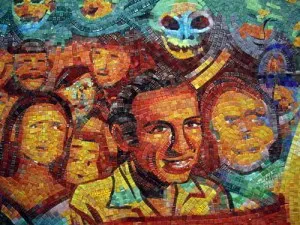
Photo: Gmariscal, CC BY-SA 3.0, via Wikimedia Commons
There's a moment that happens on almost every mural tour I've taken through the barrios of this country. Somebody stops, looks up, and asks: who gave them permission?
The answer, historically, is nobody. That's the point.
The Wall Is the Medium and the Message
Muralismo has never asked politely. When the Chicano art movement exploded in the 1970s — think Judith Baca's sweeping histories in Los Angeles, or the collective genius behind San Diego's Chicano Park — the murals weren't decoration. They were declarations. Walls in East LA and the Mission District carried faces of César Chávez, names of disappeared organizers, maps of lands that had been taken. The paint was the press release; the barrio was the newsroom.
Fifty years later, the descendants of that movement are still climbing scaffolds. But their walls are doing something new: they're registering voters.
Three Artists, Three Walls, One Fight
Spend a weekend in Chicago's Pilsen neighborhood and you'll find work by artists who treat every cinderblock like a canvas and every canvas like a campaign. In Los Angeles, muralists are embedding QR codes into portraits of farmworkers — scan the face, land on a voter registration page. In Philadelphia, a collective painted a block-long panorama of immigrant elders, then hosted a citizenship clinic at its dedication.
I spent weeks talking to three artists who represent the current wave:
The archivist. A painter in her thirties who reproduces photographs from 1960s United Farm Worker strikes at monumental scale. Her argument: "If we don't paint our own history, someone else will erase it for us." Her latest piece in Fresno includes the names of local organizers — a living honor roll, refreshed with a new name every election cycle.
The organizer. For him, the mural is the hook, not the catch. Every project he leads includes a table at the base of the wall: clipboards, registration forms, a cooler of agua frescas. "People stop for the art," he told me. "They stay because somebody hands them a pen."
The provocateur. Younger, faster, working in wheatpaste and aerosol, his pieces show up overnight and disappear just as quickly when the city sends a cleanup crew. He counts citations as receipts. "If they're power-washing my work, it was working."
Public Art as Get-Out-the-Vote Infrastructure
Here's what makes 2025 different from 1975: the murals are networked. Artists share designs across cities, coordinate release dates with community organizations, and time unveilings to registration deadlines. A wall is no longer just a monument — it's a mobilization node with a physical address.
Researchers who study civic engagement have long noted that low-barrier touchpoints matter. A mural doesn't argue with you. It doesn't need your email. It just stands there, beautiful and unignorable, in the neighborhood where you actually live — reminding you that politics happens on your block, not just on your screen.
The Erasure Problem
Of course, the walls keep disappearing. Gentrification has eaten iconic murals in the Mission, in Chicago, in Austin — often replaced with the bland abstract pastels that developers seem to think signal "safe investment." Artists call it what it is: a second erasure. First the people are pushed out, then the portraits of them are painted over.
The movement's response has been to get organized about preservation. Digital archives, drone photography, and official landmark designations are becoming part of the muralist's toolkit right alongside spray cans. Some cities have even begun requiring developer-funded conservation of significant works — a policy these artists fought for and won.
La Revolución Se Pinta Sola
There's a saying floating around the community paint days I've attended: la revolución se pinta sola — the revolution paints itself. It's meant as a joke about how many volunteers show up, but there's truth in it. These walls rise because whole neighborhoods decide they should. Abuelas bring tamales to the painters. Kids get handed brushes and told to fill in a sunflower. A wall becomes a commons.
And then, on election day, the neighborhood that painted it goes and votes under it.
That's not just art. That's infrastructure. And unlike a billboard, nobody can buy it — they can only try to paint over it. Good luck with that. We multiply.