Turn It Up: The Spanish-Language Anthems Fueling America's Protest Streets
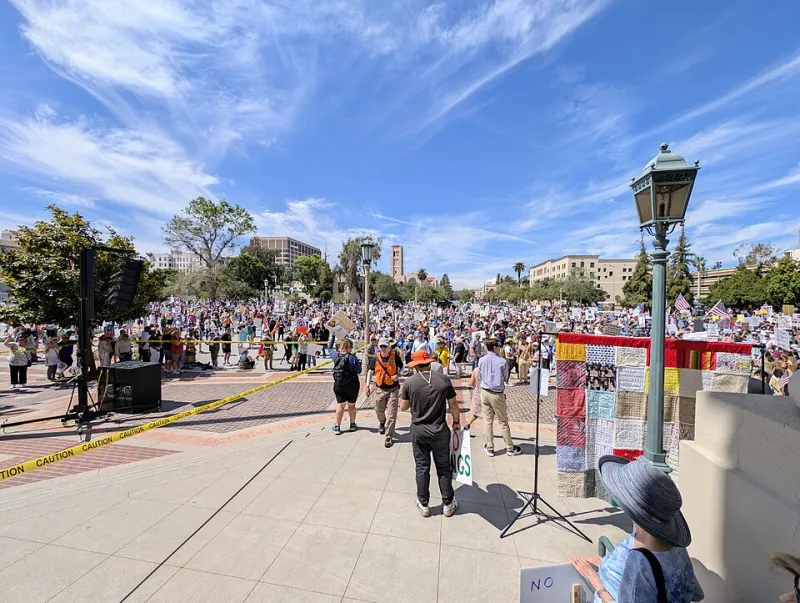
Photo: Thad Zajdowicz, CC0, via Wikimedia Commons
The first thing you hear before the march even starts isn't a chant. It's a beat.
On a sweltering Saturday in downtown Los Angeles, thousands of demonstrators are pressed against barricades near City Hall, and the sound system strapped to the back of a pickup truck is thumping a bassline that could belong in any club from Inglewood to San Juan. Except the lyrics aren't about dancing. They're about dignity.
This is the new sonic landscape of American protest — and it's overwhelmingly bilingual, unapologetically Spanish, and impossible to ignore.
From the Block to the Barricade
For decades, protest music in the United States was coded as an English-language tradition: Dylan, Springsteen, N.W.A. But walk any major demonstration over the past few years — immigration rallies, labor pickets, climate marches — and you'll catch Spanish spilling from megaphones and speakers at every corner.
The reasons are both demographic and artistic. The US is home to more than 40 million native Spanish speakers, and a wave of artists has spent the last decade fusing the genres their parents loved — boleros, corridos, salsa — with the trap and reggaetón beats of their own generation. When the political moment demanded anthems, the anthems were already written.
"We don't sit down and think, 'Let's make a protest song,'" says Marisol Vega, a singer-songwriter from Riverside whose track "Ni Una Más" went viral after clips of it playing at a union rally in Sacramento circulated on TikTok. "We write about our tías, our neighbors, the rent. If that's political, then every song is."
The Corrido Comes Home
Perhaps no genre embodies the shift like the corrido revival. Born in the borderlands as storytelling ballads about outlaws and injustice, corridos were practically designed for resistance. Today's revivalists — many of them first-generation Americans — are pointing the narrative tradition at ICE raids, wage theft, and school board battles in towns like Uvalde and Yakima.
"My abuelo sang corridos about Pancho Villa," says Joaquín Reyes, a guitarist and producer based in Fresno. "I sing about the same fight. It just wears different clothes now. He'd recognize it immediately."
Reyes describes performing at a farmworker organizing event in the Central Valley, where a crowd of sixty-year-old field laborers and their teenage grandkids sang every word together. "That's the whole movement in one image," he says.
Reggaetón with a Conscience
Reggaetón, long dismissed by critics as escapist party music, has also grown teeth. A new cohort of urban artists is smuggling political verse into club-ready production — songs about housing displacement and police violence that hit just as hard sonically as they do lyrically.
The strategy is deliberate. "If the message lives in a song people actually play at the barbecue, it travels further than any speech," Vega explains. "The revolution can't just be serious. It has to be danceable."
A Generation That Codeswitches
What unites these artists is an audience that refuses to choose between languages. Young Latino protesters quote Bad Bunny and César Chávez in the same breath, chant "¡Sí se puede!" at rallies in Philadelphia and Phoenix alike. For them, Spanish isn't a foreign language — it's the mother tongue of the movement.
Music scholars call it the bilingual soundtrack of a rising electorate. The artists call it something simpler.
"We're not making protest music," Reyes says, laughing. "We're making music for people who have to protest to be heard. There's a difference."
Either way, the streets have answered. And they're turning the volume all the way up.
La revolución vive — and right now, it has a bassline.