The Fridge on 138th Street: How Mutual Aid Became the Movement's Backbone
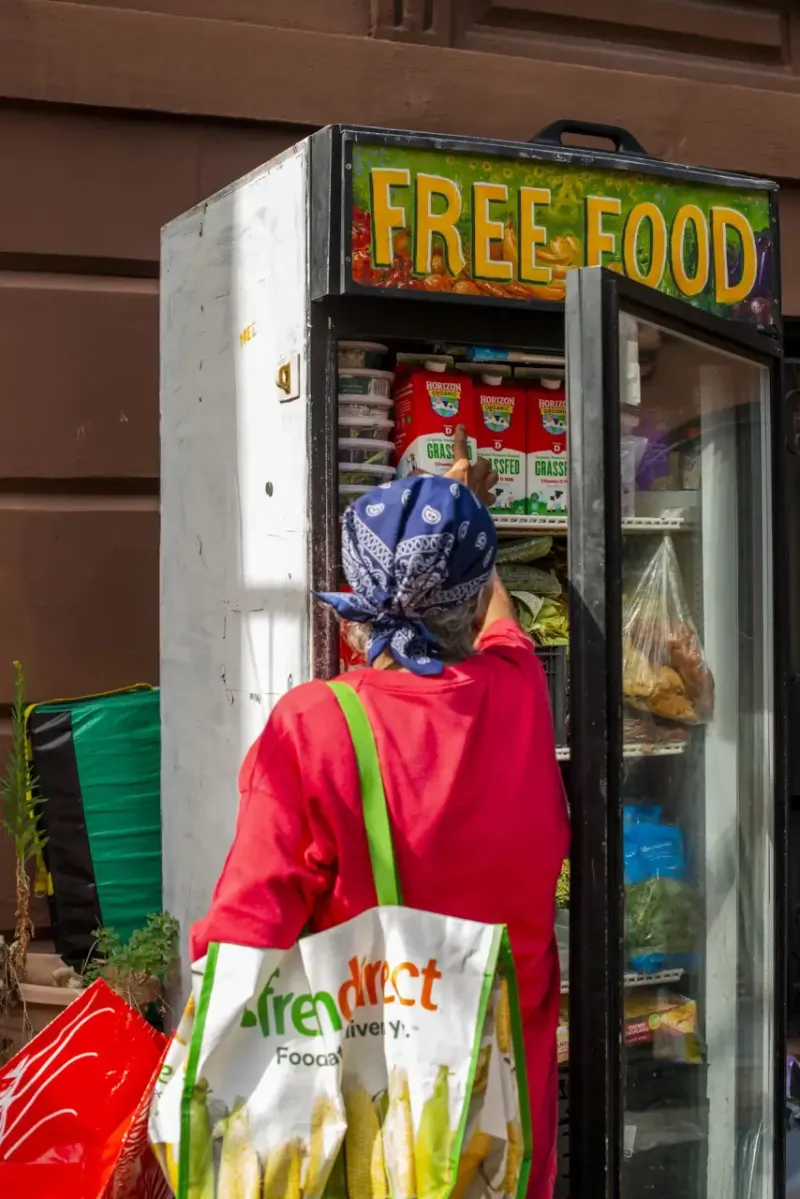
Photo: community fridge volunteers stocking food urban neighborhood, via modernfarmer.com
There's a refrigerator standing on a corner in the South Bronx that tells you more about American politics than any poll or pundit. It's painted in bright colors, stocked twice a day by volunteers, and the sign above it reads: Toma lo que necesitas, deja lo que puedas. Take what you need, leave what you can.
Nobody elected the people who maintain it. Nobody fundraised millions to keep it running. And yet, in neighborhoods like this one across the country, these small acts of organized care are becoming something bigger — the connective tissue of a movement that's learning to govern itself before it governs anyone else.
Care as a Political Act
Mutual aid isn't charity, and the organizers we spoke with are quick to draw that line. Charity flows from the top down. Mutual aid circulates sideways, neighbor to neighbor, often in Spanish, often organized through WhatsApp groups that didn't exist three years ago.
In Los Angeles, that circulation looks like the tenant defense funds that mobilize when a family faces eviction — volunteers who show up to housing court, who know the law, who pack the gallery in matching shirts. In Houston, it looks like disaster response networks that filled the gaps when the grid failed and the state didn't come. In Chicago, it looks like bilingual know-your-rights trainings held in church basements and taquerías.
The common thread? These networks are building skills, trust, and lists of names — the raw materials of political power — without ever calling themselves political.
Three Organizers, Three Lessons
Marisol, 34, the Bronx. She runs the volunteer rotation for a community fridge and food pantry network. Her insight is blunt: "The city asks us for our data when they want our vote, but when we needed food in 2020, the city asked them — us — to figure it out. So we did. Now when we knock on doors, people open them."
Andrés, 27, East Los Angeles. He came up through eviction defense and is now weighing a run for neighborhood council. "The fund taught me the law," he says. "The tenants taught me urgency. Neither one of those things comes from a candidate training."
Rosa, 51, Houston. A church volunteer turned disaster-response coordinator, she's skeptical of electoral politics but not of power. "I don't trust politicians," she laughs. "I trust a spreadsheet with four hundred names of people who showed up when it froze."
From Fridge to Ballot Box?
Here's the question that keeps movement veterans up at night: can care translate into leverage? History says maybe. The Black Panthers' free breakfast programs built credibility that outlasted the organization itself. The United Farm Workers built a movement on the same principle — serve the community first, and the community will show up when you call.
The early signs are promising. Mutual aid organizers in several cities have moved into budget advocacy, pushing city councils to fund sanitation and housing services. Others have used their networks to turn out voters in school board races — the low-salience elections where a few hundred votes can actually decide things.
But there's a risk, too. The moment these networks formalize, something can get lost. The fridge doesn't need a 501(c)(3). The WhatsApp group doesn't need a board of directors. The revolution of care works precisely because it's messy, local, and unowned.
The Real Infrastructure
Maybe the question is wrong. Maybe mutual aid doesn't need to "translate" into electoral wins to matter. Maybe it matters because it proves something every election cycle forgets: that ordinary people, organized and trusted, can meet needs that institutions have failed to meet for decades.
La revolución vive — not in a slogan, but in a stocked shelf, a packed courtroom, a phone tree that activates when the temperature drops. The infrastructure of the future is being built one neighbor at a time. Whether it runs candidates or simply runs the block, it's already here.
Want to plug in? Most local networks can be found by searching your neighborhood name plus "ayuda mutua." Show up. Bring a bag of rice.